


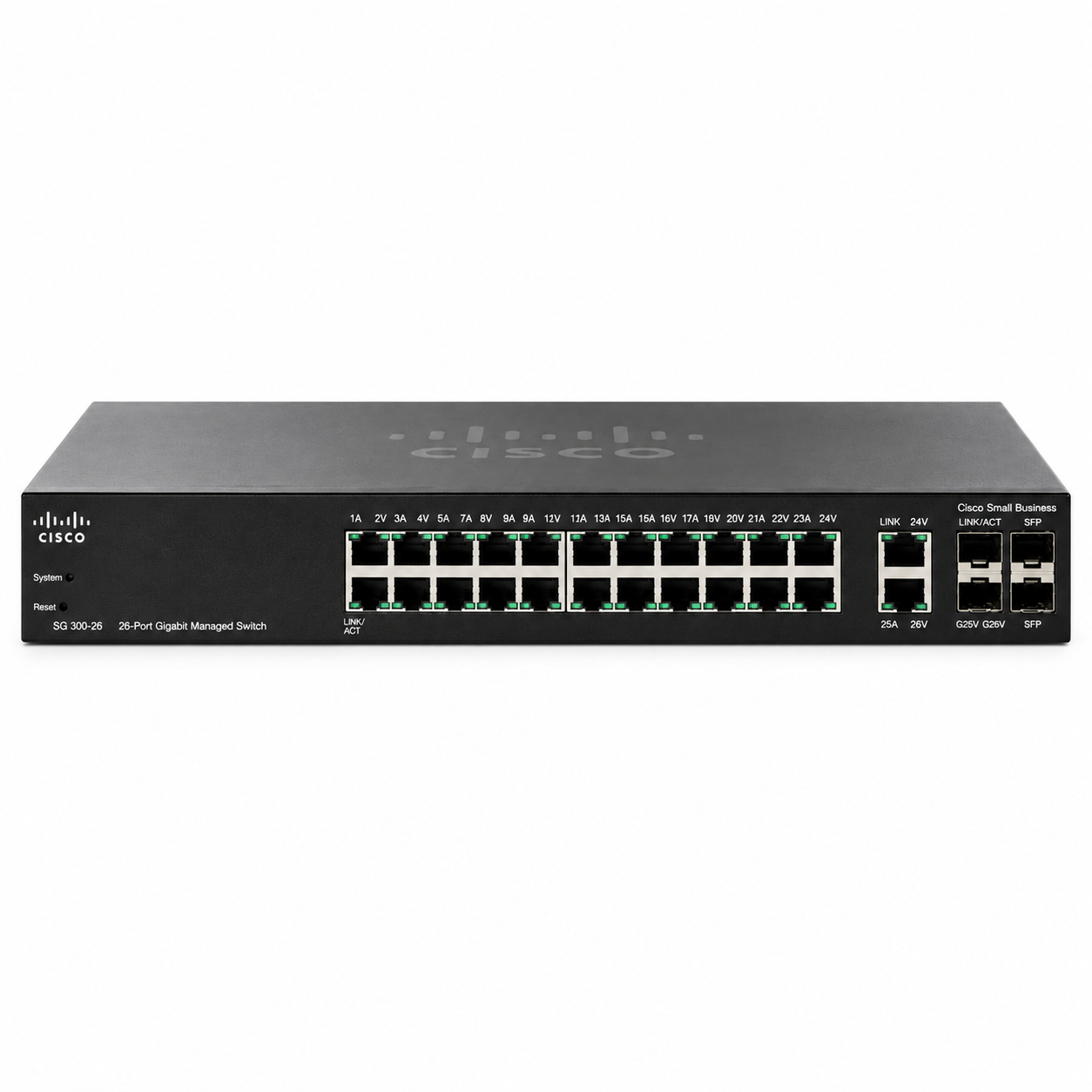

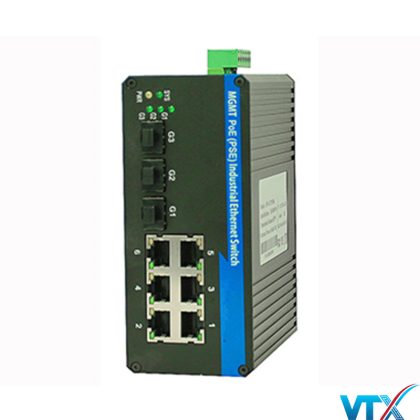
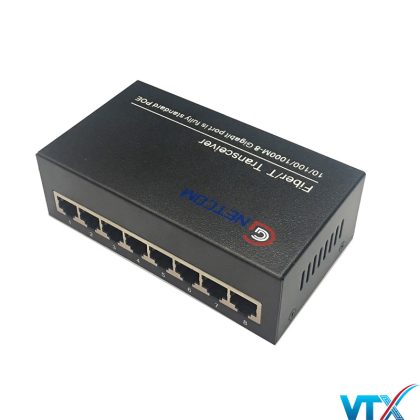
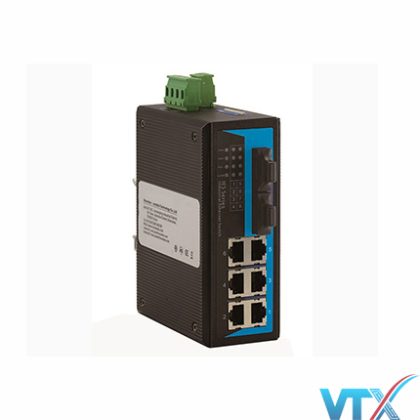
Switch mạng Cisco SG300-20 20 Port 1000Mbps
Switch mạng Cisco SG300-20 cung cấp 8 cổng tốc độ 10/100/1000Mbps. Cung cấp sự chuyển mạch hiệu suất cao, chức năng QoS dễ quản lý cho doanh nghiệp, chiến lược bảo mật nâng cao và những tính năng quản lý tốt nhất của layer 2.
Hơn nữa, bộ chia cũng được trang bị cùng 2 khe cắm SFP mang lại cho bạn sự linh hoạt khi muốn mở rộng mạng. Thiết bị này là một ý tưởng phù hợp để tiết kiệm chi phí hiệu quả cho giải pháp mạng vừa và nhỏ.
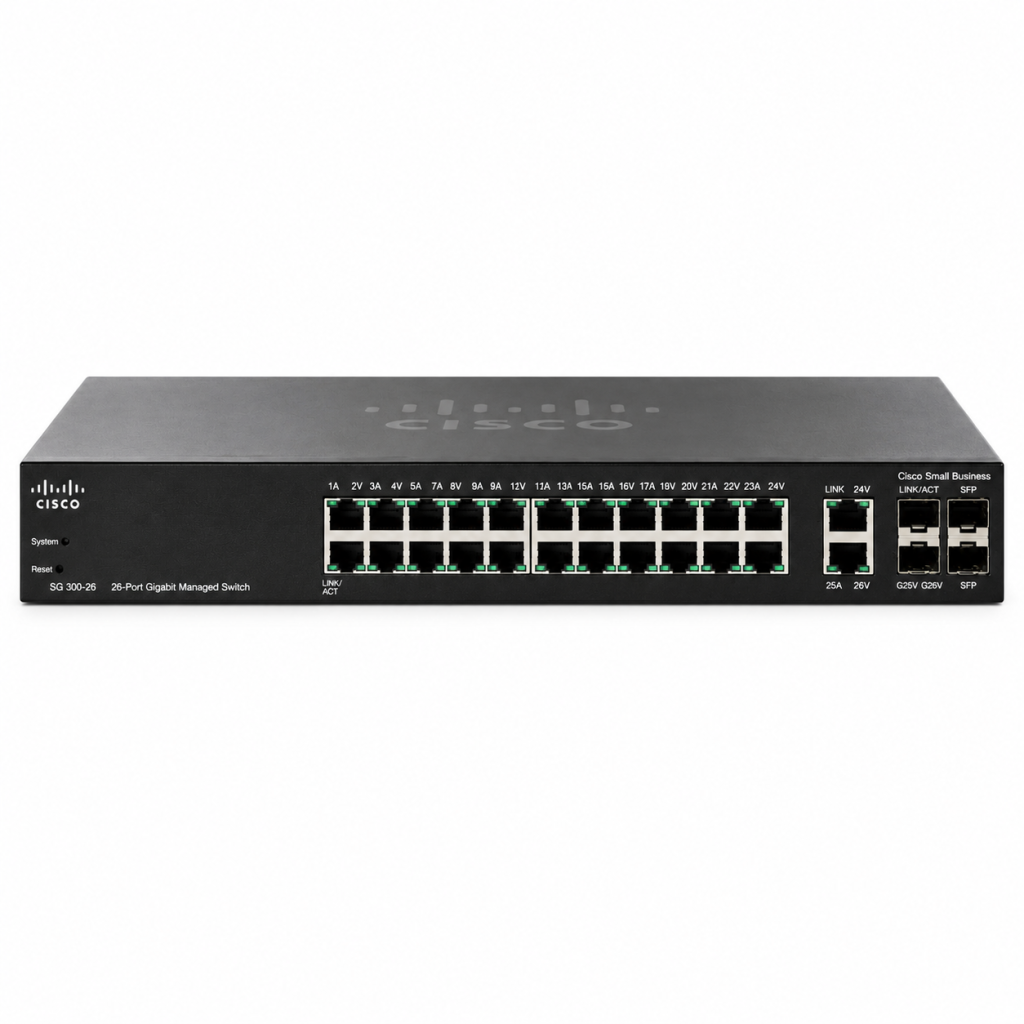
Switch Cisco SG300-20 hỗ trợ cho các công nghệ tiên tiến: Tất cả các thiết bị chuyển mạch Cisco bao gồm các tính năng giao thông xử lý tiên tiến để giữ cho các ứng dụng chạy ở hiệu suất cao điểm. Tích hợp QoS thông minh trên tất cả các mô hình tự động ưu tiên dịch vụ chậm trễ nhạy cảm như thoại hoặc video để cải thiện hiệu suất mạng.
Thông số kỹ thuật
| Performance | Capacity in Mpps (64-byte packets): 29.76 |
|---|---|
| Switching Capacity in Gbps: 40.0 | |
| Layer 2 Switching | Spanning Tree Protocol: Standard 802.1d Spanning Tree support |
| Fast convergence using 802.1w (Rapid Spanning Tree), enabled by default | |
| Multiple Spanning Tree instances using 802.1s | |
| Port Grouping: Support for IEEE 802.3ad Link Aggregation Control Protocol | |
| • Up to 8 groups | |
| • Up to 8 ports per group with 16 candidate ports for each (dynamic) 802.3ad link aggregation | |
| VLAN: Support for up to 256 VLANs simultaneously (out of 4096 VLAN IDs) | |
| Port-based and 802.1Q tag-based VLANs | |
| MAC-based VLAN | |
| Management VLAN | |
| Private VLAN Edge, also known as protected ports, with multiple uplinks | |
| Guest VLAN | |
| Unauthenticated VLAN | |
| Voice VLAN: Voice traffic is automatically assigned to a voice-specific VLAN and treated with appropriate levels of QoS | |
| Q-in-Q VLAN: VLANs transparently cross a service provider network while isolating traffic among customers | |
| Generic VLAN Registration Protocol/Generic Attribute Registration Protocol: Protocols for automatically propagating and configuring VLANs in a bridged domain | |
| Dynamic Host Configuration Protocol Relay at Layer 2: Relay of DHCP traffic to DHCP server in different VLAN. Works with DHCP Option 82 | |
| Internet Group Management Protocol Versions 1, 2 and 3 snooping: IGMP limits bandwidth-intensive multicast traffic to only the requesters; supports 256 multicast groups (source-specific multicasting is also supported) | |
| IGMP Querier: IGMP querier is used to support a Layer 2 multicast domain of snooping switches in the absence of a multicast router. | |
| Head-of-Line (HOL) Blocking: HOL blocking prevention | |
| Layer 3 | IPv4 Routing: Wirespeed routing of IPv4 packets |
| Up to 32 static routes and up to 32 IP interfaces | |
| Classless Inter-Domain Routing: Support for CIDR | |
| DHCP Relay at Layer 3: Relay of DHCP traffic across IP domains | |
| User Datagram Protocol Relay: Relay of broadcast information across Layer 3 domains for application discovery or relaying of BootP/DHCP packets | |
| Security | Secure Shell Protocol: SSH secures Telnet traffic to and from the switch; SSH v1 and v2 are supported |
| Secure Sockets Layer: SSL support: Encrypts all HTTPS traffic, allowing highly secure access to the browser-based management GUI in the switch | |
| IEEE 802.1X (Authenticator role): RADIUS authentication and accounting, MD5 hash; guest VLAN; unauthenticated VLAN, single/multiple host mode and single/multiple sessions | |
| Supports time-based 802.1X | |
| Dynamic VLAN assignment | |
| STP Bridge Protocol Data Unit Guard: A security mechanism to protect the network from invalid configurations. | |
| A port enabled for BPDU Guard is shut down if a BPDU message is received on that port | |
| Secure Core Technology: Ensures that the switch will receive and process management and protocol traffic no matter how much traffic is received | |
| Layer 3 Isolation: Allow/disallow routing between IP subnets or directly connected IP networks | |
| Layer 2 Isolation Private VLAN Edge (PVE) with community VLAN: PVE (also known as protected ports) provides Layer 2 isolation between devices in the same VLAN, supports multiple uplinks | |
| Port Security: Locks MAC addresses to ports, and limits the number of learned MAC addresses | |
| RADIUS/TACACS+: Supports RADIUS and TACACS authentication. Switch functions as a client | |
| Storm Control: Broadcast, multicast and unknown unicast | |
| DoS Prevention: DoS attack prevention | |
| Congestion Avoidance: A TCP congestion avoidance algorithm is required to minimize and prevent global TCP loss synchronization. | |
| ACLs: Support for up to 512 rules | |
| Drop or rate limit based on source and destination MAC, VLAN ID or IP address, protocol, port, differentiated services code point/IP precedence, TCP/ UDP source and destination ports, 802.1p priority, Ethernet type, Internet Control Message Protocol packets, IGMP packets, TCP flag | |
| Quality of Service | Priority Levels: 4 hardware queues |
| Scheduling: Strict priority and weighted round-robin | |
| Queue assignment based on DSCP and class of service (802.1p/CoS) | |
| Class of Service: Port based; 802.1p VLAN priority based; IPv4/v6 IP precedence/type of service/DSCP based; Differentiated Services (DiffServ); classification and re-marking ACLs, trusted QoS | |
| Rate Limiting: Ingress policer; egress shaping and rate control; per VLAN, per port and flow based | |
| Standards | IEEE 802.3 10BASE-T Ethernet, IEEE 802.3u 100BASE-TX Fast Ethernet, IEEE 802.3ab 1000BASE-T Gigabit Ethernet, IEEE 802.3ad LACP, IEEE 802.3z Gigabit Ethernet, IEEE 802.3x Flow Control, IEEE 802.1D (STP, GARP, and GVRP),IEEE 802.1Q/p VLAN, IEEE 802.1w RSTP, IEEE 802.1s Multiple STP, IEEE 802.1X Port Access Authentication, IEEE 802.3af, IEEE 802.3at, RFC 768, RFC 783, RFC 791, RFC 792, RFC 793, RFC 813, RFC 879, RFC 896, RFC 826, RFC 854, RFC 855, RFC 856, RFC 858, RFC 894, RFC 919, RFC 922, RFC 920, RFC 950, RFC 951, RFC 1042, RFC 1071, RFC 1123, RFC 1141, RFC 1155, RFC 1157, RFC 1350, RFC 1533, RFC 1541, RFC 1542, RFC 1624, RFC 1700, RFC 1867, RFC 2030, RFC 2616, RFC 2131, RFC 2132 |
| IPv6 | IPv6: IPv6 host mode |
| IPv6 over Ethernet | |
| Dual IPv6/IPv4 stack | |
| IPv6 neighbor and router discovery | |
| IPv6 stateless address auto-configuration | |
| Path maximum transmission unit discovery | |
| Duplicate address detection | |
| ICMP version 6 | |
| IPv6 over IPv4 network with Intra-Site Automatic Tunnel Addressing Protocol support | |
| IPv6 QoS: Prioritize IPv6 packets in hardware | |
| IPv6 ACL: Drop or rate limit IPv6 packets in hardware | |
| Multicast Listener Discovery Snooping: Deliver IPv6 multicast packets only to the required receivers | |
| IPv6 Applications: Web/SSL, Telnet server/SSH, ping, traceroute, Simple Network Time Protocol, Trivial File Transfer Protocol, SNMP, RADIUS, syslog, DNS client, protocol-based VLANs | |
| IPv6 RFCs Supported: RFC 2463 – ICMP version 6 | |
| RFC 3513 – IPv6 address architecture | |
| RFC 4291 – IPv6 addressing architecture | |
| RFC 2460 – IPv6 specification | |
| RFC 2461 – Neighbor discovery for IPv6 | |
| RFC 2462 – IPv6 stateless address auto-configuration | |
| RFC 1981 – Path MTU discovery | |
| RFC 4007 – IPv6 scoped address architecture | |
| RFC 3484 – Default address selection mechanism | |
| RFC 4214 – ISATAP tunneling | |
| RFC 4293 – MIB IPv6: Textual conventions and general group | |
| RFC 3595 – Textual conventions for IPv6 flow label | |
| Power Efficiency | Energy Detect: Automatically turns off power off on Gigabit Ethernet RJ-45 port when detecting link down |
| Active mode is resumed without loss of any packets when the switch detects the link up | |
| Cable Length Detection: Adjusts the signal strength based on the cable length. It reduces the power consumption for cables shorter than 10 m | |
| General Features | Jumbo Frames: Frame sizes up to 10 KB supported on 10/100 and Gigabit interfaces |
| MAC Table: Up to 8000 MAC addresses | |
| Discovery | Bonjour: The switch advertises itself using the Bonjour protocol |
| Link Layer Discovery Protocol (802.1ab) with LLDP-MED extensions: LLDP allows the switch to advertise its identification, configuration and capabilities to neighboring devices that store the data in a MIB. LLDP-MED is an enhancement to LLDP that adds the extensions needed for IP phones | |
| Cisco Discovery Protocol: The switch advertises itself using the Cisco Discovery Protocol | |
| Power Consumption | Power Savings Mode: Energy Detect |
| Short Reach | |
| Power Consumption Worst Case: 110V=22.6W | |
| 220V=23.3W | |
| Heat Dissipation (BTU/hr): 79.5 | |
| Ports | Total System Ports: 20 Gigabit Ethernet |
| RJ-45 Ports: 18 Gigabit Ethernet | |
| Combo Ports (RJ-45 + SFP): 2 Gigabit Ethernet Combo | |
| Buttons | Reset button |
| Cabling Type | Unshielded twisted pair Category 5 or better for 10BASE-T/100BASE-TX; UTP Category 5 Ethernet or better for 1000BASE-T |
| LEDs | System, Link/Act, Speed |
| Flash | 16 MB |
| CPU | 128 MB memory |
| Packet Buffer Memory | 4 MB |
| Power Supply | 100-240V 47-63 Hz, internal, universal |
| MTBF | @ 40°C (hours): 144,237 |
| Certifications | UL (UL 60950), CSA (CSA 22.2), CE mark, FCC Part 15 (CFR 47) Class A |
| Dimensions (DxWxH) | 17.3 x 1.45 x 7.97′ (440 x 36.83 x 202.5 mm) |
| Weight | 4.78 lb (2.17 kg) |
Viễn Thông Xanh là đơn vị đối tác lâu năm với Cisco tại thị trường Việt Nam. Chúng tôi luôn có sẵn đầy đủ các mã sản phẩm Switch chia mạng của Cisco và được nhập khẩu chính hãng. Quý khách có nhu cầu mua hàng hay nhận báo giá sản phẩm Switch mạng Cisco SG300-20 vui lòng liên hệ trực tiếp với chúng tôi để được tư vấn thông tin chi tiết.
Đánh giá
Chưa có đánh giá nào.